Which Air Conditioner Should You Buy in Batumi? A 2026 Buyer’s Guide
Inverter or non-inverter? What BTU size for your room? Which brands last in salty sea air? A working technician’s plain-English guide to buying the right AC the first time.
Buying an air conditioner in Batumi is easy to get wrong — the wrong size, the cheapest non-inverter unit, or a brand that rusts in two summers by the sea. This is the advice I give customers before they spend a tetri: how to pick the right type, the right capacity (BTU) for your room, the energy class that actually lowers your bill, and which brands survive our humid, salty coastal climate.
Inverter vs non-inverter — buy the inverter
A non-inverter AC runs the compressor flat-out, then switches it fully off, then on again — noisy, jumpy temperature, and heavy on electricity. An inverter air conditioner varies the compressor speed to hold a steady temperature, so it’s quieter, cools faster and uses 30–50% less power. In a city where the AC runs all summer, that saving pays back the small extra cost within a couple of seasons.
Unless it’s for a room you’ll cool for ten minutes a year, buy an inverter model. For a bedroom, living room, shop or office in Batumi, it’s the only sensible choice in 2026.
What size (BTU) do you need?
Size is measured in BTU, and getting it right matters more than the brand. Too small and the unit runs non-stop without ever cooling the room; too big and it short-cycles, never removes the humidity, and wastes money. As a rough guide for Batumi: a room up to 15 m² needs roughly a 9,000 BTU (“09”) unit, 15–25 m² a 12,000 BTU (“12”), 25–35 m² an 18,000 BTU (“18”), and 35–50 m² a 24,000 BTU (“24”).
Add capacity for a top-floor flat, big windows facing the sun, an open-plan kitchen or a room full of people. Our humid coast also means you want a unit that dehumidifies well, not just one with a big cooling number. If you tell me the room size and which way it faces, I’ll size it for you before you buy.
Energy class and the features worth paying for
Look for the energy label — a higher SEER/energy class means lower running costs for the same cooling. Over a Batumi summer the gap between a cheap low-class unit and an efficient one shows up clearly on your bill. A good inverter with a high energy rating is the cheapest unit to own, even if it isn’t the cheapest to buy.
Features that genuinely earn their place here: a strong dehumidify mode for our climate, a self-cleaning or anti-mould coil to fight the damp, a low-temperature heating mode if you want winter warmth, and Wi-Fi control if you like it. Ignore the gimmicks — airflow, efficiency and build quality are what matter.
Best brands for our coastal climate — and installation matters more
Reliable mid-to-premium brands in Georgia — names like Daikin, Mitsubishi, Gree, Midea, Haier, TCL and Samsung — all make solid inverter units. Premium Japanese brands tend to last longest and have the best dehumidification; mid-range Chinese brands offer strong value if you pick an inverter model with a good warranty. Near the boulevard, ask about corrosion-protected (“blue fin” / anti-corrosion) coils, because salt air eats unprotected outdoor units.
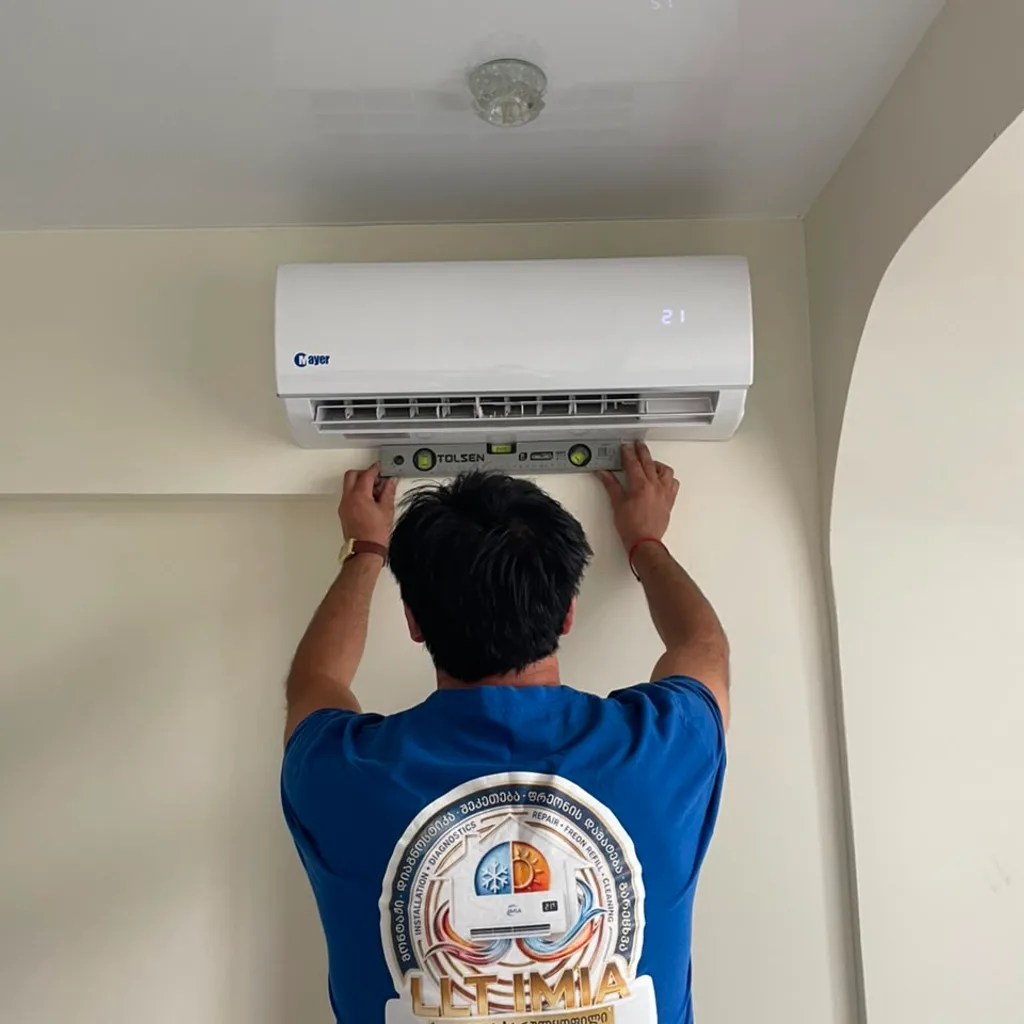
Here’s the part most shops won’t tell you: a great unit installed badly will under-perform and leak. Correct pipe length, a proper vacuum, the right drainage fall and a sound electrical connection make more difference to real-world cooling than the badge on the front. Buy a good inverter, size it right, and have it installed properly — that’s the whole formula.
Frequently asked questions
Which air conditioner brands last best in Batumi sea air?
Any of the well-known brands Imia services — Daikin, Mitsubishi, Gree, Midea, Haier, TCL and Samsung — will last on the coast if the outdoor coil has a corrosion-resistant (blue-fin or equivalent) coating and gets cleaned annually. Salt air, not the badge, is what kills coastal outdoor units early.
Is an inverter air conditioner worth the extra money?
Yes, in Batumi. An inverter varies compressor speed instead of switching fully on and off, so it holds a steadier temperature, dehumidifies better and uses roughly 30–50% less electricity. Over a coastal summer where the unit runs daily, the price difference typically pays back within two seasons.
Should I buy a bigger air conditioner than I need, to be safe?
No. An oversized unit cools to the set temperature too fast, short-cycles, and never runs long enough to strip humidity out of the air — so a Batumi room ends up cold and clammy, and the compressor wears from constant starting. Size it to the room: 9,000 BTU for 25–30 m², 12,000 BTU for 35–40 m².